Something about the flooded island in the middle of Laguna de Bay brings a creeping sense of déjà vu. A village marooned on the lake, ravaged in the name of progress then cast aside because it is a mere dot in the water...it is the story of Nunal sa Tubig (A Speck in the Water) coming true.
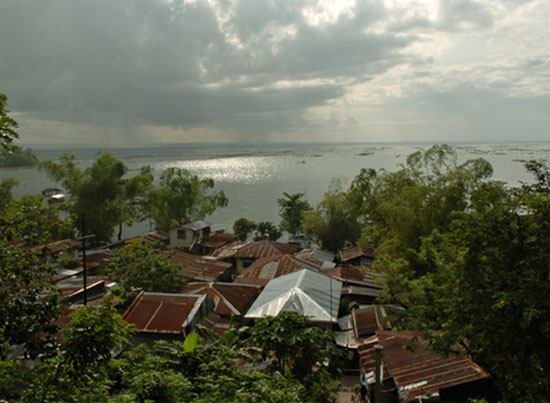
Beleaguered Talim Island in the middle of Laguna de Bay is like a malignant mole (nunal) exposing the sickness of the lake. Laguna de Bay is the largest lake in the Philippines, and the second largest in Southeast Asia. The lake is 42% bigger than the entire Metro Manila.
Ishmael Bernal’s dystopian vision of Laguna de Bay, which few understood back in 1976, has been brought to life by the twin tempests Ondoy (international name Ketsana) and Pepeng (international name Parma), whose waters refuse to recede from Talim Island one month after the great deluge. As end-of-the-world signs go, this is not on the scale of famine, pestilence, or rivers turning into blood, but still, today’s
taga-isla (islanders) can’t help but wonder whose sins it is they are being punished for. A village with no landlines, cable TV, cars or factories spewing fumes into the air is drowning in the fallout of economic growth it never knew.
Venice in Binangonan The disaster tourist’s journey to Talim begins in Binangonan, Rizal, about an hour’s drive from Metro Manila. From there, it takes thirty minutes to two-and-a-half hours on a motorized banca to reach the seventeen barangays on the island that fall under the jurisdiction of Binangonan (the other nine are under Cardona, Cavite).
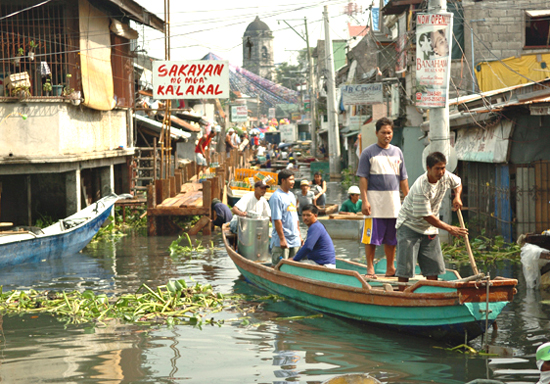
This area near the port of Binangonan is still recognizable from the 1976 film Nunal sa Tubig (A Speck in the Water), except there was no tubig (water). The lake is now part of the street, with water lilies to match.
The small but busy road leading to Binangonan’s pritil (port) is still recognizable from Bernal’s film. Tricycles weave in and out of the crowds, while the bell tower of St. Ursula’s Church looms in the background. Since the swelling of Laguna de Bay turned part of the road into the Grand Canal last month, however, a new form of transport has sailed into town. Locals simply call it the
lampitaw, a leaky tub made of plastic, wood, or metal scrap propelled by men tethered to the hull by a rope. They ferry passengers from one side of the road to the other, charging P5.00 to P10.00 per person. Same price for squealing hogs and sacks of rice. Venice in Binangonan does not stop with this improved gondola. For sun protection, lampitaw gondolieri wear pointy-nosed cloth masks that would fit right in with the birdmen at Carnevale.
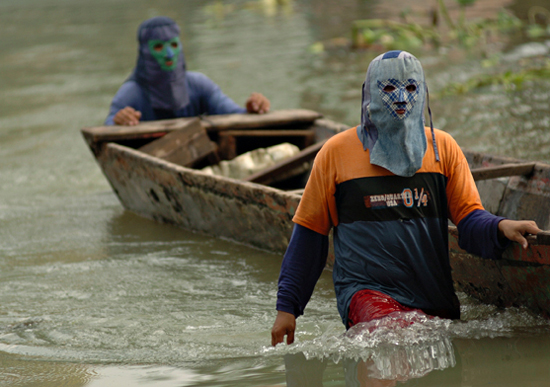
The cloth masks worn by Binangonan’s “gondoliers" would fit right in with the birdmen at the Venice Carnevale.
“Do Not Enter," a leftover road sign barks at the top of the street where the waterline now starts. Smug water lilies floating in from the lake gleefully ignore it. In retaliation, a boy spears them with a rake as they glide in. Revenge is sweet. As the lake becomes more polluted, the blooms grow more stubborn and profuse. They destroy fish traps and form thick groves that force bancas to consume more fuel as they cut through. This is one battle man can still win over nature—for now. The narrow footbridge lining the watery trail to the port materialized about two weeks after Ondoy and Pepeng struck. Lampitaw operators complain that they lose passengers as the gangplank grows longer and longer. Still, cargo business remains good. No one wants to jostle through the shaky bridge with squealing hogs and sacks of rice. From the footbridge, the sunken remains of a gas station and an ice plant’s delivery truck (“Perishable Goods, Do Not Delay") balefully remind townsfolk that life is not back to normal, despite sari-sari stores swiftly recovering from shock and setting up hot dog displays within arm’s reach from the bridge.
(see next page) True-to-life movie At last, the embarkation area. The long jetty that used to jut out into the lake has vanished underwater. Bancas are parked on water lily beds so thick they look beached on dry land. As each boat is loaded to capacity, it mows down the creepers before sputtering away. 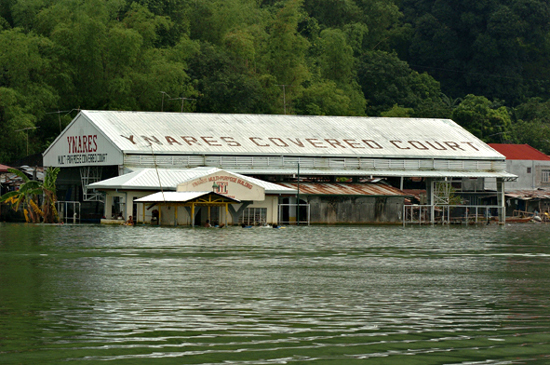
Drowned basketball courts and waiting sheds have become part of the furniture of Laguna de Bay.
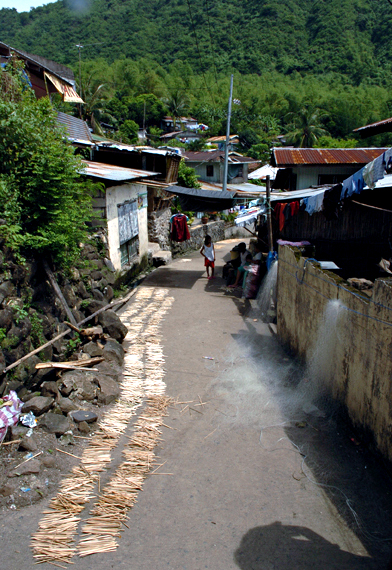
Panicked villagers ran up and down “main street" of Barangay Ginoong Sanay shouting “Timog na! (South)!" when Typhoon Ondoy whipped thru the island and cut off the outside world.
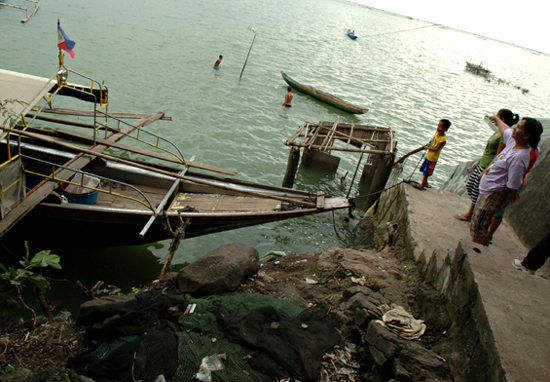
The pier of Barangay Ginoong Sanay is submerged somewhere around this spot, where passengers now have to leap off a precipice to get on bancas.
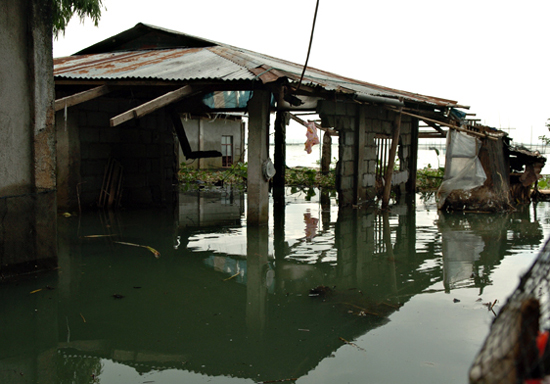
The swelling of Laguna de Bay has erased the fairly wide shore of Talim Island. Waves and fallen anahaw palms crashed through this concrete house that used to be a substantial distance from the water.
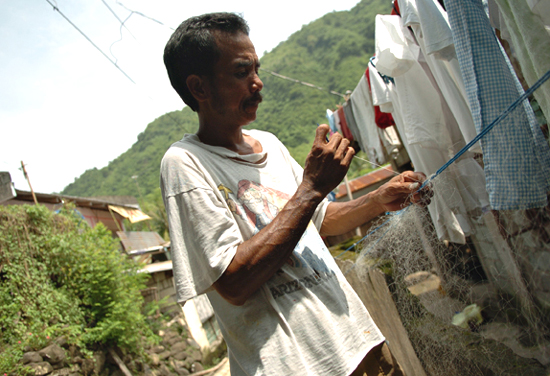
Fish are getting scarce on the lake, so fisherman Zalde moonlights as a construction worker on the mainland whenever he can.

Catching fish that escape from fish pens is part of day-to-day survival on Talim Island.
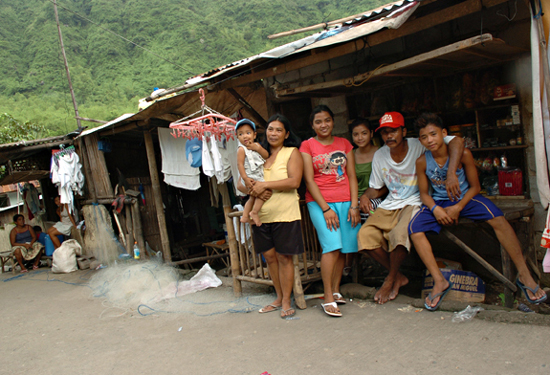
Editha and Zalde of Barangay Ginoong Sanay strike a pose in front of their sari-sari store with daughter May and their other children.
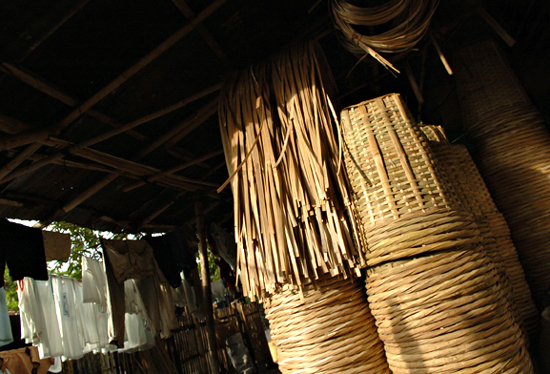
Talim Island’s craggy terrain can be inhospitable, but it yields a lot of bamboo, which is made into large baskets (kaing) in Barangay Buhangin. One basket takes 2 hours to make by hand, from bamboo that takes 1-3 years to grow. A basket is sold for only P20 to wholesale buyers in Divisoria.
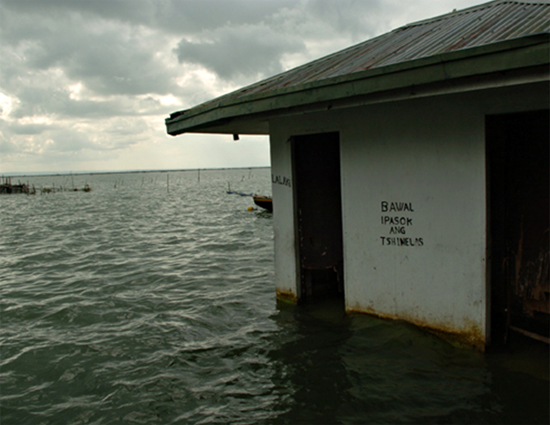
Beneath these waters lies the sunken port of Barangay Ginoong Sanay. All that’s left of it are the smashed toilets on the right.


 GMA Brandtalk
 Tracking
 Archives


